Compare six disclosure avoidance methods side by side and see how each one changes a hypothetical census table.
Federal statistical agencies use a variety of techniques—known collectively as disclosure avoidance—to protect the confidentiality of the people and businesses represented in publicly released data. For decades, agencies have selected the methods best suited to each statistical product based on legal, technical, and operational considerations.
On June 4, 2026, the U.S. Department of Commerce issued Department Administrative Order 216-26, which limits the disclosure avoidance methods that may be used for Census Bureau and BEA statistical products, identifies coarsening as the preferred approach for protecting confidentiality, and prohibits differential privacy and other forms of noise infusion. This is a departure from previous practice, which left those decisions primarily to the statistical agencies themselves. Several professional associations—including the Association of Population Centers, APDU, COPAFS, ICPSR, and the Population Association of America—issued a joint statement raising concerns about the order and calling for it to be rescinded.
If "coarsening" isn't part of your everyday vocabulary, you're not alone. It's an umbrella term for techniques that reduce precision, such as rounding values, aggregating small geographic areas into larger ones, and reporting ranges instead of exact counts. These approaches have long histories in federal statistics, but they've generally been used in combination with other disclosure avoidance techniques rather than as the primary line of defense.
The order leaves many practical questions unanswered. How will agencies implement coarsening in practice? What will it mean for data availability in small geographic areas and for population subgroups? Is record swapping—used to protect decennial census data from 1990 through 2010—considered a form of noise infusion? Will the transition delay the release of statistical products? So far, federal agencies haven't provided guidance on how they plan to implement the new order.
In the meantime, we thought it would be helpful to illustrate how these methods could affect published data. We created the Disclosure Avoidance Explorer, a new interactive tool that lets you compare six disclosure avoidance methods side by side. Apply each method to a hypothetical census table and see how different approaches balance confidentiality protection with data utility.
The Explorer includes a brief explanation of each method and is intended as an educational tool rather than a prediction of how federal statistical agencies will implement the new policy. Real-world performance depends on the statistical product being protected and how each method is implemented.
▶ Launch the Disclosure Avoidance Explorer
Screenshot shown below. Click the link above to open the interactive Explorer.
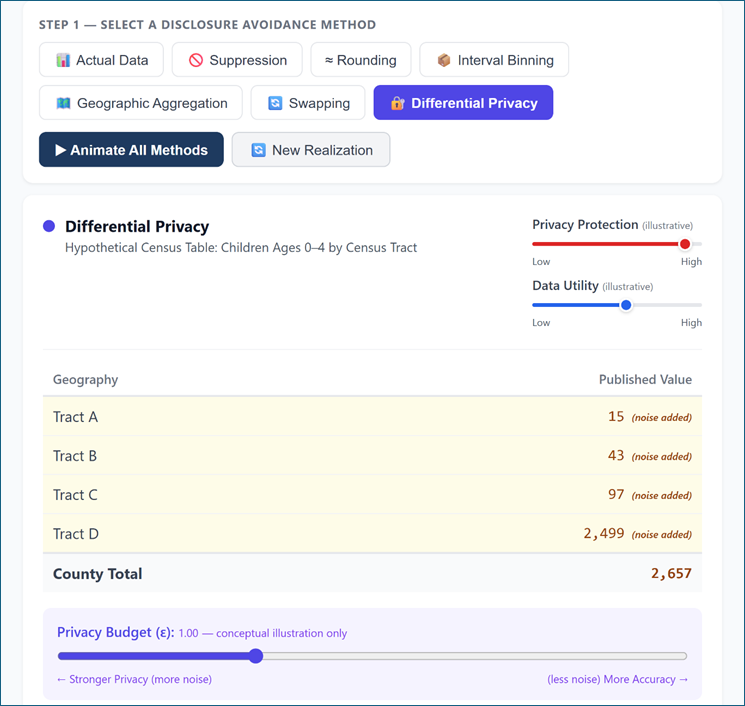
No disclosure avoidance method is "best" in the abstract. Each one strikes a different balance between protecting confidentiality and preserving the usefulness of the data, and the right balance depends on the product, the users, and the risks. That's the conversation the federal government needs to have with the data community in the months ahead, and we hope this Explorer helps make those discussions a little more concrete.
For readers interested in the history behind these methods, Beth Jarosz and I collaborated with Census Bureau experts on a brief, Why the Census Bureau Chose Differential Privacy, explaining why the Bureau adopted differential privacy for the 2020 Census and how it compares with earlier disclosure avoidance techniques.
Have questions, ideas, or feedback? We'd love to hear what you think. Add your comment below or join the discussion on PRB's Federal Data Forum.