Federal Data Users

 View Only
  • 1.  New Census Bureau noncitizen voting brief

    Posted 4 hours ago

    Yesterday the Census Bureau released Noncitizen Voting in the 2020 Election, A Beginning Analysis, which links a commercial voter file to federal administrative records and reports ~24,000 noncitizen voters in the 2020 election, with 32 million records "yet to analyze."

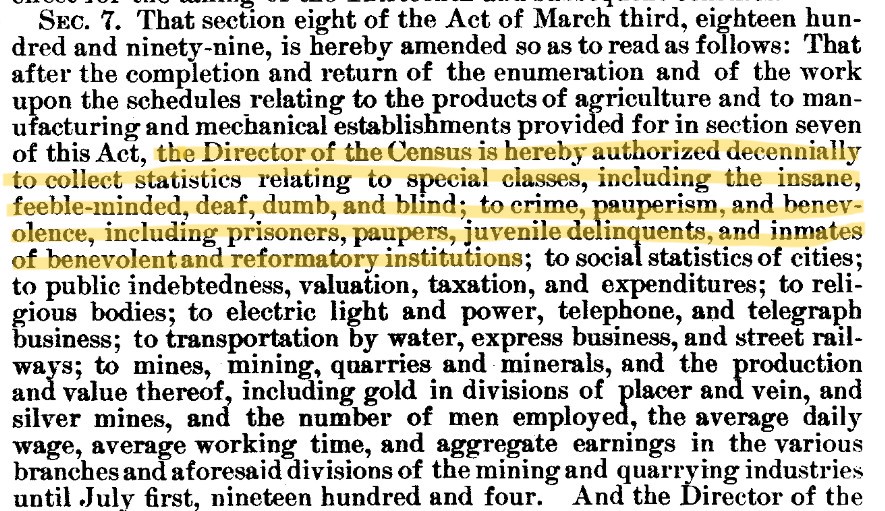
    The brief frames this work in terms of a Census Bureau crime-statistics mandate dating back to 1902. The history is more complicated: the 1902 act authorized decennial statistics on "crime, pauperism, and benevolence, including prisoners, paupers, juvenile delinquents, and inmates of benevolent and reformatory institutions"-in other words, counting people already in institutions, not identifying potential lawbreakers. The Bureau discontinued its national Judicial Criminal Statistics program after 1945, and its prisoner-statistics work subsequently shifted to the Justice Department.
    I'm concerned about the potential chilling effect of this work. The brief notes that the analysts "did not have access to the names of the population analyzed or any other identifying information." And the Bureau is publishing aggregate statistics, not identifiable records. But this still sends a potentially troubling message about how administrative data shared with the Census Bureau might be used.

    The Bureau's own research found that households containing noncitizens were particularly sensitive to citizenship-related data collection. A 2024 Census study found reduced response, increased household-roster omissions and internet breakoffs, and an increased undercount among households with noncitizens. 

    It's telling that no statistician or researcher put their name on this report-unlike virtually every other Census Bureau publication. Mike Schneider has a nice piece on that if you want to learn more:https://countofcounting.substack.com/p/no-researchers-name-is-on-census

    Anyone have any other thoughts about this? I'd especially welcome perspectives from folks who know more about Census Bureau history than me. 


    ------------------------------
    Mark Mather
    Associate VP
    PRB
    ------------------------------


  • 2.  RE: New Census Bureau noncitizen voting brief

    Posted 4 hours ago
    Re Mar's post:  "I'm concerned about the potential chilling effect of this work."

    All,

    I'm concerned too, and suspect that this forum could do good things to sort out the actual sequence of events, what happened when, why, how, etc., so we can think about responses and support for the bureau going forward.

    Mike Schneder, Count of Counting and Hansi Lo Wang, NPR have both posted more information this am.  If I understand their posts correctly, the president referenced a Census Bureau study on Truth Social saying he won the 2020 election, and subsequently, the Commerce Secretary posted the study on the bureau website.  I don't know the mechanics of that, but confirmation would be good.

    Who ordered the study and when?  I presume in the current administration, but did the impetus come from the White House, Commerce Department, request from another agency like Homeland Security?   Getting details on when it started, how bureau officials responded, would help.  Who is paying for it? Where in the bureau is the work being done? Did the bureau have a planned release schedule for results?  Was that preempted by the Truth Social post?


    The historical analogies are many, in addition to Mark's example.  The one that first came to mind for me was the 2003 Arab tabs controversy.  In 2002, Homeland Security asked for a tabulation from the 2000 census of "Arabs" by zipcode.  The bureau provided the tabulation using the 'ancestry' variable from the sampled 2000 census long form, but did not immediately release a public file on what would now be the special tabulations page on the website.  The Electronic Privacy Information Center filed a FOIA, and by August 2003, the issue was reported in the NYT.  There were differences from the current situation; the releases were tabular, sampled, not reports on matched microdata.  But the 'sensitive' nature of the release was obvious to the public and generated much heat. Let me stop for now, and if I have time, I'll add more.


    There are many threads to disentangle. 

    Margo Anderson